IOverture: one syllable, five meanings
Say the word fire aloud five times, and you will have said five different things. Let the voice fall from a height, and it is an alarm or an order. Let it rise, and it is a question, perhaps an incredulous one. Let it fall and then lift at the end, and it carries a reservation: fire, yes, but that is not the whole story. Let it climb and then drop, with the vowel stretched, and it is admiration, the sense in which a younger speaker calls a song fire. Let it sit low and level, and it is resignation, the fourth alarm of the week. Every English speaker performs these distinctions without instruction and hears them without effort. Almost no English speaker can name a single one of them.
That is the paradox this essay takes up. English is routinely described as a language without tone, in contrast to Mandarin or Yoruba, where pitch is part of the dictionary entry for a word. The description is true in the narrow sense and false in every sense that matters to a listener. English has a rich and systematic melody. What it lacks is a folk vocabulary for that melody. The speaker who says fire with a fall-rise knows exactly what they mean, and the hearer knows exactly what was meant, but neither can say afterward what was done, except to gesture at tone of voice or the way you said it.
The monosyllable is the sharpest instrument for examining this. In a long sentence, the melody has room to spread out, and a listener can attribute its meaning to the words, the order, the pause before the verb. On a single syllable there is nowhere to hide. The whole tune must be performed on one vowel, in a fraction of a second, and whatever meaning arrives beyond the dictionary sense of fire has arrived through pitch, length, loudness, and the quality of the voice alone. The word is a kind of laboratory specimen: a case where everything the alphabet cannot write is present, and nothing else is.
The essay proceeds in three movements. It first sets the linguistic record straight, since the vocabulary the ordinary speaker lacks does exist, in a scholarly tradition that has been describing English tunes for the better part of a century. It then asks why the single syllable is the purest case, and what the comparison with true tone languages reveals. Finally it turns to literature, which has been fighting the limits of the written page on exactly this front since there has been a written page, and to the everyday writing of the present, where the missing channel has become a source of real misunderstanding between people who know each other well.
Five ways to say fire
Choose a tune. The contour is drawn on Chao's five pitch levels.- O'Connor & Arnold
- Halliday
- ToBI
- Chao levels
Labels follow the two traditions described in section II. The level contour has no primary tone in Halliday's system; O'Connor and Arnold's Terrace is the nearest named group.
IIThe vocabulary that exists, and the vocabulary that doesn’t
The claim that English speakers lack words for tone needs one correction before it can be accepted. The words exist. They belong to a scholarly tradition rather than to the kitchen table, and that is precisely the point: the gap is not between English and tone, but between what English speakers do and what they can say about it.
The British tradition described English melody in terms of tunes. Its mature statement is the handbook by J. D. O’Connor and G. F. Arnold, Intonation of Colloquial English (first edition 1961, second 1973), which sorts the nuclear tones of English into a small inventory, high fall, low fall, high rise, low rise, fall-rise, rise-fall, and level, and then groups them into ten named tone groups with deliberately homely labels: the Low Drop, the High Drop, the Take-Off, the Low Bounce, the Switchback, the Long Jump, the High Bounce, the Jackknife, the High Dive, the Terrace. Each group was paired with a catalogue of attitudes it conveyed on each sentence type. The Switchback, their name for the fall-rise, is the one that makes fire mean fire, but. M. A. K. Halliday’s Intonation and Grammar in British English (1967) proposed an independent system built on five primary tones, numbered one through five, with compound tones beyond them: fall, high rise, low rise, fall-rise, rise-fall. He also separated three decisions a speaker makes in any utterance, which he called tonality (where the tune boundaries fall), tonicity (which syllable carries the nucleus), and tone (which melody that nucleus takes). On the word fire spoken alone, the first two decisions are made for you. Only tone remains, which is why the word is such a clean test.
The American tradition rebuilt the same territory out of levels rather than tunes. Janet Pierrehumbert’s 1980 MIT dissertation, The Phonology and Phonetics of English Intonation, proposed that every English contour could be generated from a string of just two tonal targets, high and low, arranged into pitch accents on stressed syllables, phrase accents, and boundary tones at the edges. The system that grew from it, ToBI (Tones and Break Indices), writes a falling fire as roughly H* L-L% and a rising one as L* H-H%, and distinguishes a plain high accent H* from the scooped L+H* that a speaker uses to mark contrast. Dwight Bolinger, working in parallel and often in dissent, argued across Intonation and Its Parts (1986) and Intonation and Its Uses (1989) that beneath all the conventional detail lay a universal core of feeling: up is open, uncertain, incomplete, deferential; down is closed, certain, finished, assertive. D. Robert Ladd’s Intonational Phonology (1996, second edition 2008) is the standard synthesis of the two traditions.
So a linguist, asked what happened when someone said fire with a fall-rise, could answer in three different notations and would mean the same thing by all of them. What the ordinary speaker has instead is a thin and oblique folk lexicon:
- Tone of voice, which names the channel without naming any value in it.
- Uptalk or high rising terminal, the one contour that has entered public conversation, mostly as a complaint about the young.
- Flat, clipped, sing-song, whiny, snippy, sharp, warm: adjectives that describe the social effect of a tune, never its shape.
- It’s not what you said, it’s how you said it, which is the whole problem stated as a grievance.
The asymmetry is worth dwelling on. Most of the grammar of English is similarly unconscious, but for most of it there is at least a school vocabulary: noun, verb, past tense, plural. Children are drilled on the apostrophe and never once told that the fall-rise exists. The result is that the dimension of language in which disputes so often arise, how something was meant, is the one for which speakers have been given no instrument of description at all. They are left to litigate it with adjectives.
IIIWhy the monosyllable is the purest case
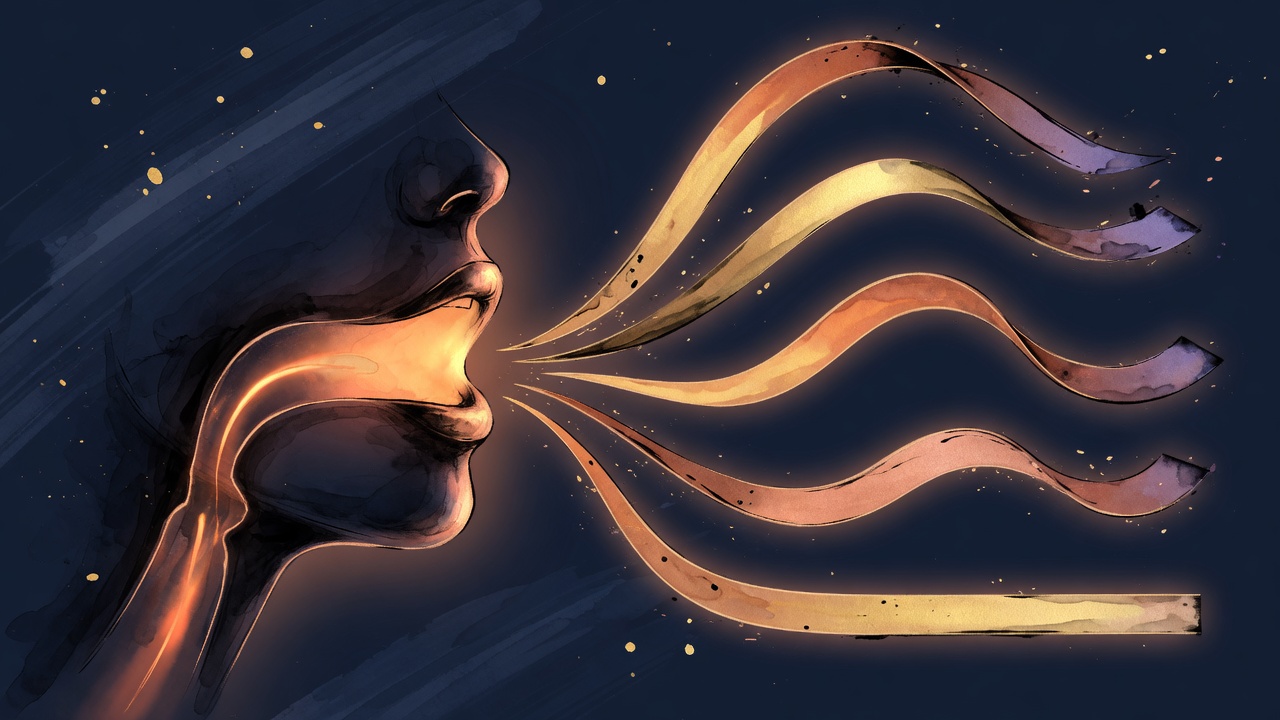
An English tune is normally distributed across a stretch of speech. In the fire is in the kitchen, the melody begins somewhere before the first stress, moves through a head, lands its nucleus on kitchen, and finishes its tail on the final unstressed syllable. The listener hears the shape at leisure. When the utterance shrinks to a single syllable, the whole architecture collapses onto one vowel. There is no head, no tail, no room to run. Nucleus and boundary must both be performed on fire at once, in something under half a second.
This compression has two consequences, and together they explain why one-word utterances feel so charged.
The first is that the contour becomes entirely audible as contour. On a long phrase a listener can misattribute the meaning of the tune to the words or the syntax. On a monosyllable there is nothing else to credit. Whatever fire means beyond combustion has been carried by pitch movement, by the length of the vowel, by loudness, and by voice quality, the breathiness or creak or tension with which the sound is produced. The phoneticians call these the suprasegmentals, the features that ride above the string of consonants and vowels, and the single syllable is the only place where they are heard completely alone.
The second is that the syllable stretches to make room. A two-direction tune needs time, so fire said with a fall-rise tends to run longer than fire said as a falling alarm, even though the vowel is already a long diphthong. The slang sense of excellence seems to follow the same rule: it is usually drawn out, and the lengthened rise-fall reads as appreciation. That is an observation rather than a measured finding, but the principle behind it is not in doubt. The duration is not decoration. It is a consequence of needing room to execute the contour.
The tradition recognises this in the words it chooses as examples. The classic demonstration pieces of English intonation are nearly all monosyllables:
- Oh, which can be a whole turn in a conversation, and which Erving Goffman catalogued among his response cries and John Heritage, in 1984, analysed as a change-of-state token, the sound of a mind being updated.
- No, which Halliday’s five tones turn into denial, protest, a question, a reluctant concession, and a scandalised refusal.
- Yes, the word on which Molly Bloom’s soliloquy ends, and which readers have been performing differently to themselves for a century.
- Well, whose fall-rise introduces every polite disagreement in the language.
- Fine, which every English-speaking couple knows can mean its own opposite.
- Right, sure, great, really, each of which has an ironic reading that lives entirely in the tune.
There is a further subtlety that Christine Gunlogson’s True to Form (2003) drew out for rising declaratives. A rise does not simply make a question. It shifts who is committed to the proposition. Fire with a fall commits the speaker: I assert there is a fire. Fire with a rise attributes the claim to the hearer and asks whether they will stand behind it: you are saying there is a fire? The grammar is identical, the dictionary entry is identical, and the whole difference in who owns the claim has been settled by the direction of a pitch movement lasting a few hundred milliseconds. On a monosyllable this is laid bare. There is not even a subject and verb to pretend the meaning came from.
The lesson is that the monosyllable is not a degenerate case of the sentence but its purest form. It is speech reduced to what the alphabet cannot record.
It is speech reduced to what the alphabet cannot record.
IVTone and intonation across languages
The statement that English has no tone means something precise. In a tone language, pitch is lexical: it belongs to the word, and changing it changes which word has been said. The Mandarin syllable ma is four words, five with the toneless particle, depending on whether the pitch is high and level, rising, dipping, or falling, and the dictionary lists them separately. In English, pitch is post-lexical: it belongs to the utterance, and changing it changes what the speaker meant by a word whose identity is not in doubt. Fire with a rise is still fire. The distinction is real, but it is a distinction in where the melody attaches, not in whether there is a melody.
The modern tool for writing a tone contour phonetically was invented for Chinese. In 1930 Yuen Ren Chao published a system of tone letters in Le Maître Phonétique: a vertical staff of five pitch levels, numbered one at the bottom to five at the top, with a line drawn against it tracing the contour of a syllable. Mandarin’s four tones become 55, 35, 214, 51. The levels are relative to a single speaker’s range, so the notation describes shape rather than absolute frequency, and the International Phonetic Association later adopted the letters. What is striking is that the same five-level staff can transcribe the English fire perfectly well: an alarm is something like 51, a question 35, a reservation 315, an appreciation 351. The notation does not care whether the tune belongs to the lexicon or the speaker. Only the grammar does.
There is also a layer beneath both systems that seems to be shared. John Ohala’s frequency code (1984) proposed an ethological explanation for why so many unrelated languages pair high or rising pitch with questions, politeness, and deference, and low or falling pitch with assertion, finality, and authority. Large animals have low voices; small animals have high ones. A rise mimics smallness and non-threat, which is what a question or a request performs socially. A fall mimics size and command. Russell Ultan’s 1969 sample found rising question intonation in 38 of 53 languages, and Bolinger, pooling that with earlier surveys in 1978, argued that the rise was close to universal, though it is not; Annie Rialland has documented a belt of West African languages that mark questions with lax, falling prosody instead. The code is a tendency, not a law, but it is a tendency old enough to be visible in the alarm call of fire, which falls, and the doubt of fire?, which rises, in languages that share no ancestor.
Second-language learners reveal the system by stumbling over it. A Mandarin speaker learning English has spent a lifetime treating pitch as part of the word and must now learn to hear it as part of the attitude. The common result is to miss English intonation altogether, hearing fire with a fall-rise as simply fire, and to be read as abrupt in return, because the fall-rise that softens an English refusal has been replaced by a flat tone that English ears hear as curt. An English speaker learning Mandarin makes the mirror error, letting the emotional rise of a question lift the lexical tone of the final syllable and thereby saying a different word. Each learner is struggling against the same fact from opposite sides: the pitch channel is always on, and each language has already decided what it is for.
So the honest formulation is not that English lacks tone. It is that English spends its tone on attitude where Mandarin spends it on vocabulary, and that because English has spent it there, English speakers were never taught to see it as spending at all.
VThe literary record: fighting the missing channel
Writers have known about the gap for as long as there has been writing, because every writer who has tried to put a human voice on the page has run into it. The alphabet records consonants and vowels. It records almost nothing of pitch, length, loudness, or voice quality, and so it records almost nothing of the dimension in which fire has five meanings. Literature’s history on this front is a history of workarounds, and the most ambitious writers are the ones who have fought hardest.
Shakespeare’s five nevers. In the last scene of King Lear, the king enters with Cordelia dead in his arms and says, in the 1623 Folio text, Never, never, never, never, never. The 1608 Quarto has the word only three times; the Folio extends it to five, and the five fill an entire line of verse. It is often read as a line of five trochees in a play written in iambs, every foot inverted, the metre turned upside down by grief. But the meaning of the line is not in the metre. It is in the question the line forces on every actor who has ever played the part: does the word fall five times identically, like a bell, or does each never take a different tune, from protest to recognition to exhaustion? Shakespeare gives one word and no instruction. He has written the purest possible monosyllabic test and handed the whole of its meaning to the voice.
Hopkins and the marks on the page. Gerard Manley Hopkins came closer than any English poet to a notation for the performed line. Convinced that his sprung rhythm could not be recovered from the bare text, he covered his manuscripts with accents, loops, and twirls marking stress, outrides, and pauses, apologising to Robert Bridges that he must use marks at all, and telling him in 1877 that his verse was less to be read than heard, that it was oratorical. These are marks for rhythm rather than pitch, but the impulse is the one this essay is tracing: the written line was not enough, and the poet reached for diacritics. Bridges, editing the poems for publication in 1918, dropped most of them. Later editors have been restoring them ever since, and the argument about what the marks mean is, at bottom, an argument about how much of a poem’s performance can be written down at all.
Frost and the sound of sense. Robert Frost’s theory of poetry, set out in letters to John Bartlett in 1913 and 1914, rested on something he called the sound of sense, and his illustration of it is as clear a description of English intonation as any non-linguist has given. The best place to hear it, he wrote in July 1913, was through a closed door that cut off the words. What remained was a conversation with its meaning intact, carried by nothing but tune, and the examples he gave work only when performed: You mean to tell me you can’t read? I said no such thing. Well read then. You’re not my teacher. The following February he put the principle in a sentence: The ear does it. The ear is the only true writer and the only true reader. Frost’s project in North of Boston was to make blank verse a vessel for these sentence-sounds, to write lines so shaped by the speaking voice that a reader would be forced to perform the right contour. He was, in effect, trying to make the page carry the fall-rise.
Dickinson, Sterne, and the dash. Before Frost, the main instrument for the job was the dash, and two writers made it an intonation mark. Laurence Sterne’s Tristram Shandy is scored in dashes of varying lengths, pauses measured for the speaking voice. Emily Dickinson’s dashes have been read for a century as everything from breath marks to pitch marks to musical rests, and the fact that no two editors agree is itself the evidence: she was notating something the alphabet has no character for, and the readers who follow have had to guess which something.
Joyce and the long yes. Ulysses ends on a monosyllable. Molly Bloom’s soliloquy, which has run for some forty pages with almost no punctuation, closes on yes I said yes I will Yes, and the final Yes carries a capital letter and nothing else. Joyce, who hated quotation marks and called them perverted commas, had stripped the page of nearly every conventional tone cue precisely so that the voice would have to be supplied by the reader. The last word is the ultimate case. Everyone who has read the book has performed that Yes to themselves, and the readings do not match, because Joyce gave the word and withheld the tune.
Beckett and the toneless voice. Samuel Beckett went the opposite direction and tried to legislate the tune out of existence. The stage directions for Play require faces impassive throughout, voices toneless except where expression is indicated, and a rapid tempo throughout. In Not I he attacked the channel from the other side, through speed. The text carries no tempo marking, but Beckett coached Billie Whitelaw toward a delivery so fast that the contours, screams and laughs included, arrive quicker than a listener can sort them. The two experiments are instructive together: one starves the channel and the other floods it. A toneless English is almost unbearable to listen to, not because it is empty but because the listener’s whole apparatus for finding meaning in melody is running at full capacity and finding nothing. Beckett proved the channel exists by closing it.
Shaw and the phonetician. One further figure belongs here because he joined the two traditions. Henry Sweet, whose Handbook of Phonetics (1877) is among the first systematic treatments of English intonation, lies behind Henry Higgins in Shaw’s Pygmalion. Shaw’s preface denies that Higgins is a portrait of Sweet while admitting touches of him, and Shaw, a lifelong campaigner against English spelling, built a play around the idea that a person’s whole social fate lives in the channel the alphabet cannot write, and gave his heroine’s turning point to a monosyllable: Eliza’s Garn, which no spelling can make a reader hear.
Beckett proved the channel exists by closing it.
VIThe rhetorical tradition and the ethics of the shouted word
The ancients did not lack the vocabulary. They had a whole discipline for it. Of the five canons of classical rhetoric, the last, pronuntiatio or actio, was delivery, and its first component was the voice. In the eleventh book of the Institutio Oratoria, Quintilian puts voice before gesture, since gesture is shaped to fit it, and calls the adaptation of the voice to the subject and its moods the most important point of all. He repeats the story, which Cicero also tells, that Demosthenes, asked what mattered first, second, and third in oratory, answered delivery each time. A mediocre speech with full command of the voice, Quintilian says, will outdo the finest speech without it. This is the fall-rise elevated to a profession. The Roman orator was trained in the tunes of assertion, doubt, irony, and appeal exactly as the modern actor is, and had a technical literature for them, one that the eighteenth-century elocutionists revived and that the modern speaker has lost again.
The actor inherited the discipline when the orator gave it up. Every rehearsal room is a laboratory of intonation. The director’s note try it as a question or land it harder is an instruction about contour, and the actor’s craft consists largely in knowing, without a notation, that a line has a dozen available tunes and choosing one. The folk vocabulary of the rehearsal room, throw it away, lift it, sit on it, colour it, is the richest everyday English has for the subject, and it is still a vocabulary of metaphor rather than description.
There is also an ethics here, and the word fire is its canonical instance. In 1919 Justice Oliver Wendell Holmes wrote, in Schenck v. United States, that the most stringent protection of free speech would not protect a man in falsely shouting fire in a theatre and causing a panic. The sentence is nearly always quoted for its legal point, and the legal hinge is the word falsely: the wrong is the lie. But the example works as an example only because of its other verb. Fire shouted with a high fall is not a report but a warning, a speech act in J. L. Austin’s sense, and what the law cares about is its perlocutionary effect, the panic. Holmes did not write saying fire. He wrote shouting, and the force of the illustration lives in that word, which is to say in loudness and contour. Had the man said fire with a fall-rise, musing, there would have been no panic, whatever the truth of the matter.
The same word in the same building with a different tune is a different act. The law understood this before linguistics had a notation for it, and the rhetoricians understood it two thousand years before the law.
VIIWriting’s workarounds, from the Greek accent to the emoji
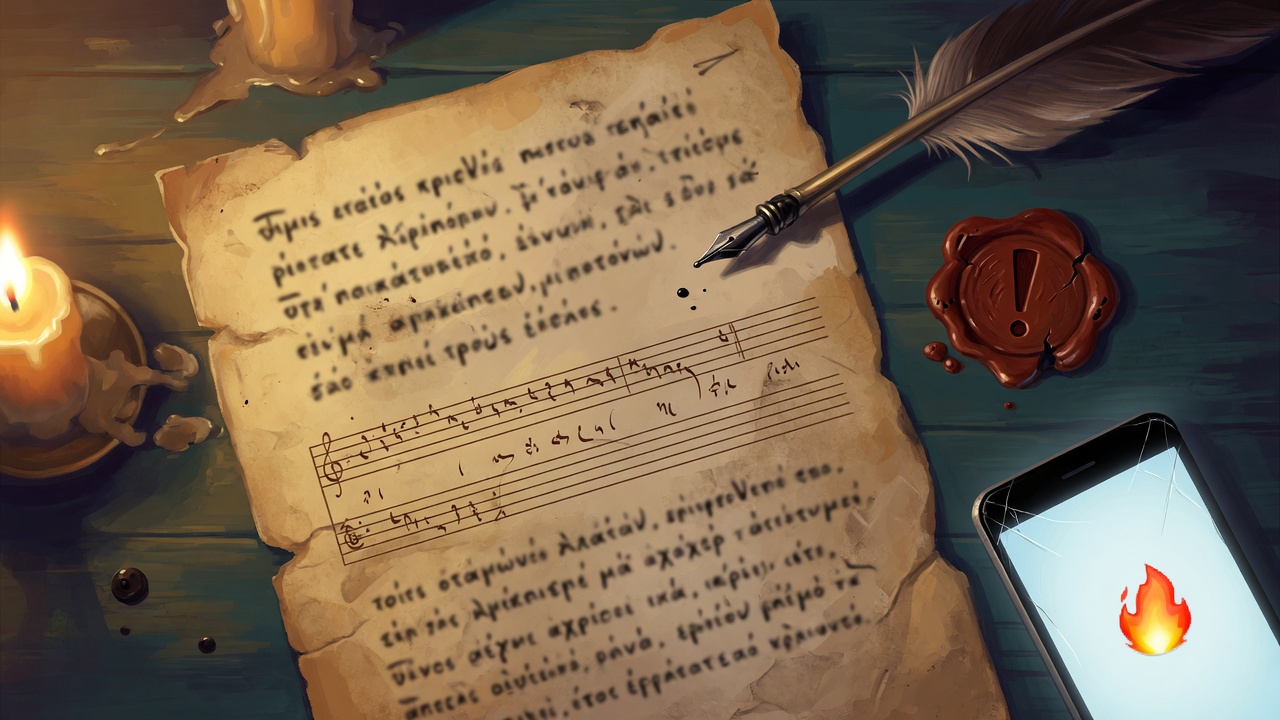
The alphabet did once write pitch, and lost it. The acute, grave, and circumflex accents of Greek, credited to Aristophanes of Byzantium around 200 BC, were originally pitch marks: the acute a rising tone, the grave a low one, the circumflex a rise and fall on a single long vowel. They were probably devised so that readers who no longer commanded the old pronunciation could recover it from the page. In the terms of this essay they recorded tone rather than intonation, since the Greek accent was lexical, a property of the word. But they are the one case of a European alphabet carrying pitch at all, and when Greek lost its pitch accent the marks survived as fossils, their descendants in French and elsewhere now marking vowel quality or nothing. The attempt ended as decoration.
The nearest thing to a true intonation notation came much later and from an unexpected quarter. Joshua Steele’s Prosodia Rationalis (1775) set English speech on a musical staff, with slides for the rise and fall of the voice, and used it to record how David Garrick spoke Hamlet. The elocutionists of his century, Thomas Sheridan and John Walker among them, built a teaching literature on such ideas, and it did not survive into general literacy. Steele’s staves are the proof that the thing can be written. The two centuries of neglect since are the proof that nobody wanted to read it.
Everything else has been improvisation, and the history of punctuation is largely the history of that improvisation. Malcolm Parkes’s Pause and Effect (1992) traces the marks from the scribe’s need to tell a reader where to breathe. The exclamation mark is the clearest case. Iacopo Alpoleio da Urbisaglia, an Italian writer of the 1360s, claimed to have invented the punctus admirativus because he was annoyed that people read emotional passages in a flat voice. It is, in other words, a tone mark: the first glyph in the modern repertoire whose sole purpose is to tell a reader which tune to perform. The question mark does the same for the rise of a yes-no question, and says nothing about the fall of a wh-question. Italics, capitals, and the ellipsis followed, each a partial and blunt instrument. Henry Denham proposed a reversed question mark in the 1580s to signal a rhetorical question, the percontation point; it did not survive, and neither did any of the dozen sarcasm marks proposed since, down to the SarcMark of 2010. The failure is consistent. A reader can be told that a sentence is emphatic or interrogative. A reader cannot be told, by any mark the alphabet has accepted, that fire carries a fall-rise.
The digital age made the problem acute, because for the first time most of humanity’s casual conversation began to happen in writing. Speech that had always been performed was now being typed, and the channel that carried half its meaning was simply gone. The consequences are measurable. A 2016 study by Gunraj and colleagues, Texting insincerely, found that one-word text replies ending in a period were rated as less sincere than the same words without one, and that the effect vanished for handwritten notes. The period had become a tone mark. It was being read as the low fall, final and cold, the contour of fine. said by someone who is not fine. The people in the study had no vocabulary for what they were hearing in the punctuation. They heard it anyway.
Every other feature of informal digital writing can be read as a patch over the same gap:
- Capitals for loudness, a prosodic feature the alphabet had no other way to carry.
- Repeated letters for length: fiiiire, the appreciative rise-fall made visible by stretching the vowel on the page as it is stretched in the mouth.
- lol and haha, which long ago stopped reporting laughter and became markers of the light tone that a fall-rise would carry in speech.
- The tilde, the slash-s, the trailing ellipsis, each an attempt at a sarcasm or hedge mark that the printed tradition refused.
- Emoji, the most widely adopted workaround yet, a parallel channel bolted onto the alphabet precisely to carry attitude. A face after fire does the work of the contour. The flame emoji after fire disambiguates the slang reading entirely.
This is why so many arguments conducted by text are not about what was said. Two people who would never have misunderstood each other across a table misunderstand each other over a message because one typed fine and the other performed it with the wrong tune. The vocabulary gap that began as a curiosity about a one-syllable word turns out to reach into ordinary domestic life. People are not fighting about words. They are fighting about contours that neither of them can name, in a medium that cannot carry them.
People are not fighting about words. They are fighting about contours that neither of them can name.
VIIICoda: what fire teaches
The observation that started this essay was modest: a one-syllable word confuses people because English speakers have no vocabulary for its tone. The claim survives examination, with one refinement that makes it larger rather than smaller. English speakers do not lack the vocabulary because the phenomenon is marginal. They lack it because it is so central, so continuous, and so early-learned that it was never experienced as a thing to be named. Children command the basic contours of English before anyone teaches them grammar, and school then gives the past tense a lesson and the fall-rise nothing.
Three conclusions follow.
First, meaning is not in the word. The dictionary entry for fire is a floor, not a ceiling. What a speaker means by it is built on that floor out of pitch, length, loudness, and voice, and on a monosyllable those materials are everything. Any theory of language that stops at the lexicon has stopped before the interesting part begins. Frost knew this, and so did Quintilian, and so does every actor and every parent who has heard their own name said in a tone that meant trouble.
Second, the alphabet is a lossy recording. It was never designed to carry tune. Its one ancient attempt at pitch decayed into accent marks that now mark nothing, Steele’s staves found no readers, and every repair since, from the exclamation mark to the emoji, has been a patch. The writers who matter on this subject are the ones who understood the loss and worked inside it, by notating, by shaping, or by withholding. None of them solved it, and the problem is still open.
Third, the gap has a cost. It was tolerable while speech stayed in the air and writing stayed formal. It is less tolerable now that the bulk of ordinary conversation passes through a channel that strips the tune, between people who have no words for what has been stripped. The practical argument for teaching intonation, for giving ordinary speakers the five tones or the ten tone groups or even the plain distinction between a fall and a fall-rise, is not that it would make anyone a linguist. It is that people who can name a thing can argue about it, and people who cannot name it argue about something else instead.
Fire, then, is interesting for exactly the reason proposed at the start. It is a single syllable that carries a whole grammar nobody was taught, performed by everyone, written by no one, and heard without fail.
SourcesPages opened for this essay
Works cited without a link, among them Heritage's 1984 paper on the change-of-state token, Ultan's 1969 survey of interrogative systems, Bolinger's 1978 essay on intonation across languages, Steele's Prosodia Rationalis, Shaw's preface to Pygmalion, Ladd's Intonational Phonology, Parkes's Pause and Effect, Austin's How to Do Things with Words, Sweet's Handbook of Phonetics, and the texts of Shakespeare, Joyce, and Beckett, are standard editions cited from the authors' knowledge.
- O'Connor and Arnold, Intonation of Colloquial English, 2nd ed. 1973: catalogue record
- Halliday, intonation in meaning: Equinox chapter
- Pierrehumbert, The Phonology and Phonetics of English Intonation, MIT 1980: DSpace record
- Bolinger, Intonation and Its Parts (1986) and Intonation and Its Uses (1989): Stanford University Press
- Gunlogson, True to Form (2003): Routledge
- Ohala's frequency code and question intonation: Max Planck Institute summary
- Chao's tone letters (1930): overview
- Frost's letters to John Bartlett on the sound of sense: Yale Open Courses handout
- Hopkins's manuscript marks and the Bridges edition: PMLA review
- Beckett's Not I and Billie Whitelaw: Adam Mars-Jones, London Review of Books
- Quintilian, Institutio Oratoria Book 11: Perseids text
- Alpoleio and the exclamation mark: Grammarphobia
- Gunraj et al., Texting insincerely (2016): SUNY Research Connect